
Keywords are the foundation of SEO. If nobody is searching for what you’re writing about, you won’t get traffic from Google—no matter how hard you try. Before we dive deep into the intricacies of keyword research and how to find the best keywords for your business, let’s make sure we understand the basics.
Table of Contents
What is keyword research?
Keyword research is the process of understanding the language your target customers use when searching for your products, services, and content. It then involves analyzing, comparing, and prioritizing the best keyword opportunities for your website.
Why is keyword research important?
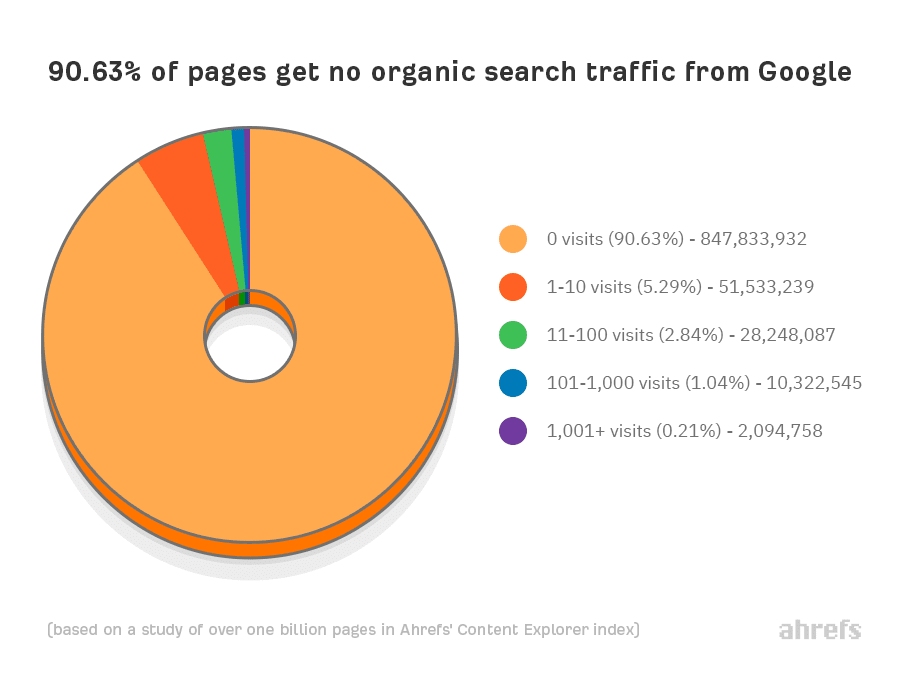
Keyword research is the only way to figure out what people are typing into search engines. You need to know this to avoid creating content about things that nobody is searching for. Many website owners make that mistake, and it’s likely a big part of the reason why 90.63% of pages get no traffic from Google, according to our study.
Keyword research also helps you to answer questions like:
- How hard will it be to rank for this keyword?
- How much traffic am I likely to get if I rank for this keyword?
- What kind of content should I create to rank for this keyword?
- Are people searching for this keyword likely to become my customers?
Finding the right answers to these questions will help you pick your battles wisely.
How to find keyword ideas through keyword research
Keyword research starts with thinking about how potential customers might be searching for your business or website. You can then use keyword research tools to expand on those ideas and find even more keywords through keyword research.
It’s a simple process, but two things need to be true to do it well:
- You need to have good knowledge of your industry.
- You need to understand how keyword research tools work and how to get the most out of them.
How to find keyword ideas through keyword research?
Keyword research starts with thinking about how potential customers might be searching for your business or website. You can then use keyword research tools to expand on those ideas and find even more keywords.
It’s a simple process, but two things need to be true to do it well:
- You need to have good knowledge of your industry.
- You need to understand how keyword research tools work and how to get the most out of them.
In this chapter, we’ll run through a few actionable ways to improve your knowledge in both those areas and discover potentially winning keywords for your website in the process.
- Brainstorm ‘seed’ keywords
- See what keywords your competitors rank for
- Use keyword research tools
- Study your niche
1. Brainstorm ‘seed’ keywords
Seed keywords are the foundation of the keyword research process. They define your niche and help you identify your competitors. Every keyword research tool asks for a seed keyword, which it then uses to generate a huge list of keyword ideas (more on that shortly).
If you already have a product or business that you want to promote online, coming up with seed keywords is easy. Just think about what people type into Google to find what you offer.
For example, if you sell coffee machines and equipment, then seed keywords might be:
- coffee
- espresso
- cappuccino
- french press
Note that seed keywords themselves won’t necessarily be worth targeting with pages on your website. As the name suggests, you’ll use them as ‘seeds’ for the next steps in this process. So don’t obsess too much over your seed keywords. It should only take a few minutes to find them. As soon as you have a handful of broad ideas related to your website’s topic, move on to the next step.
See what keywords your competitors rank for
Looking at which keywords already send traffic to your competitors is usually the best way to start keyword research. But first, you need to identify those competitors. That’s where your brainstormed list of keywords comes in handy. Just search Google for one of your seed keywords and see who ranks on the front page.
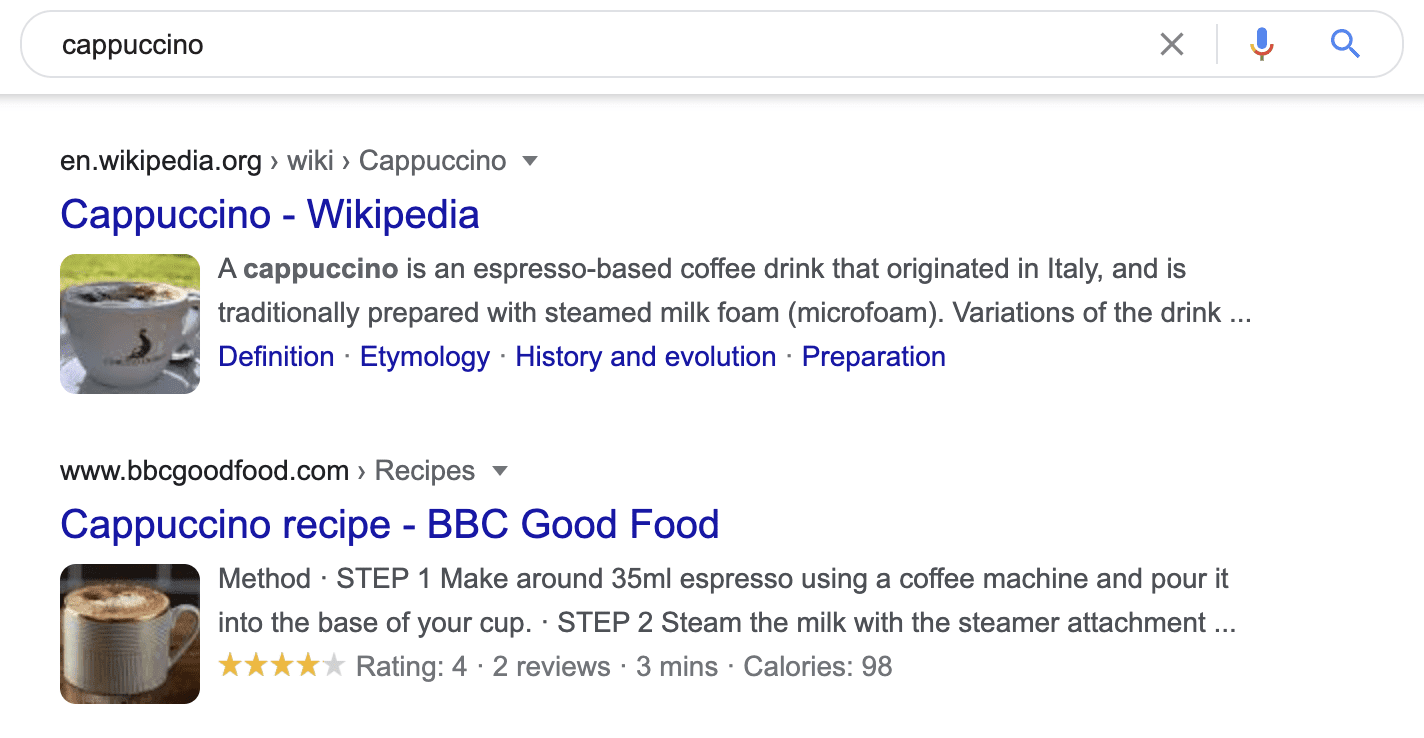
If none of the top-ranking websites for your seed keywords are like your site (or where you’re trying to take it), try searching for relevant ‘autosuggest’ queries instead.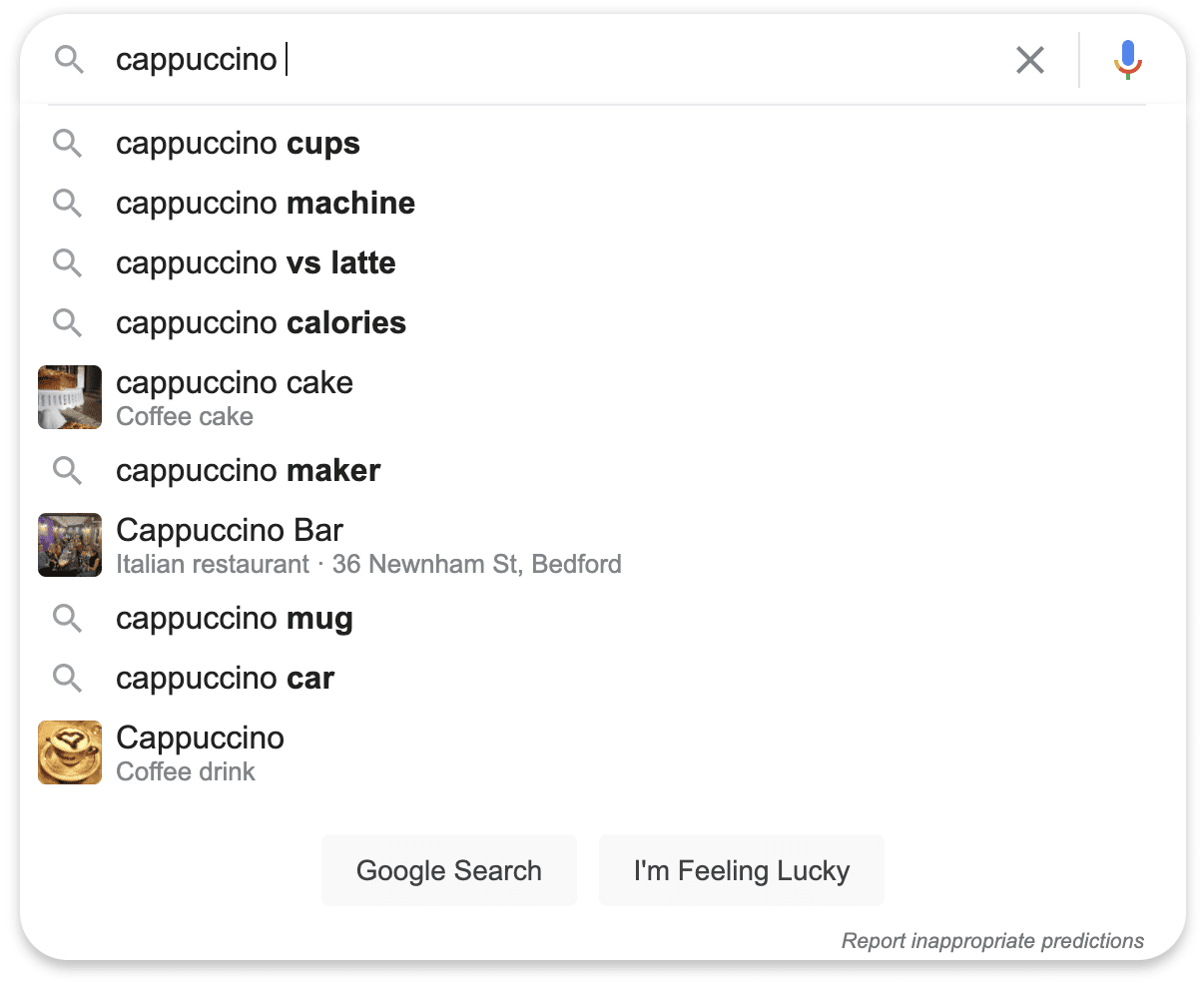
Google’s ‘autosuggest’ queries pop up as you type your query.
For example, if you sell coffee equipment, you might find more actual competitors in the search results for “cappuccino maker” than “cappuccino.” That’s because it’s mostly eCommerce stores like yours ranking for the former, and blogs ranking for the latter.
Either way, you still need to use your best judgment when determining competing websites. If you see huge brands like Amazon or The New York Times ranking for your seed keyword, you shouldn’t necessarily treat them as competitors. Always look for websites that resemble your own—or where you’re trying to take it.
Once you find a few websites that fit the bill, you can plug these websites into a competitive intelligence tool like Ahrefs’ Site Explorer one by one, then check the Top Pages report. You’ll then see their popular pages by estimated monthly search traffic. The report also shows each page’s “Top keyword” through keyword research. That’s the one sending it the most organic traffic.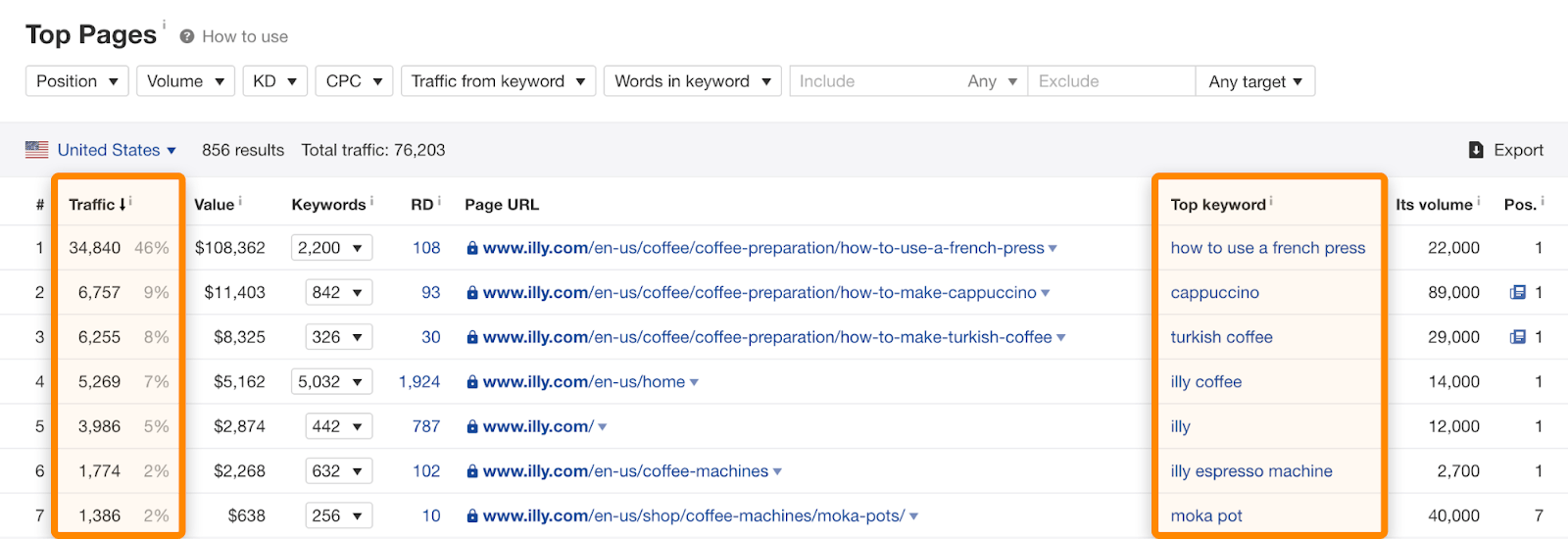
Data via the Top Pages report in Ahrefs’ Site Explorer.
Here are a few interesting keywords we discovered for our hypothetical coffee store, just by analyzing one competing website with Site Explorer:
- how to use a french press
- turkish coffee
- moka pot
- how to make coffee
- neapolitan coffee maker
As you can see, even if you’re quite familiar with your industry, you can still find plenty of unique keyword ideas by studying your competitors that you probably wouldn’t have found from brainstorming alone.
If you checked all the competitors in the search results but still want more keywords, you can find more competitors in the Competing Domains report in Site Explorer. Just plug in one of your known competitors, and it’ll suggest other similar sites based on the number of the overlapping keywords that they rank for Google. 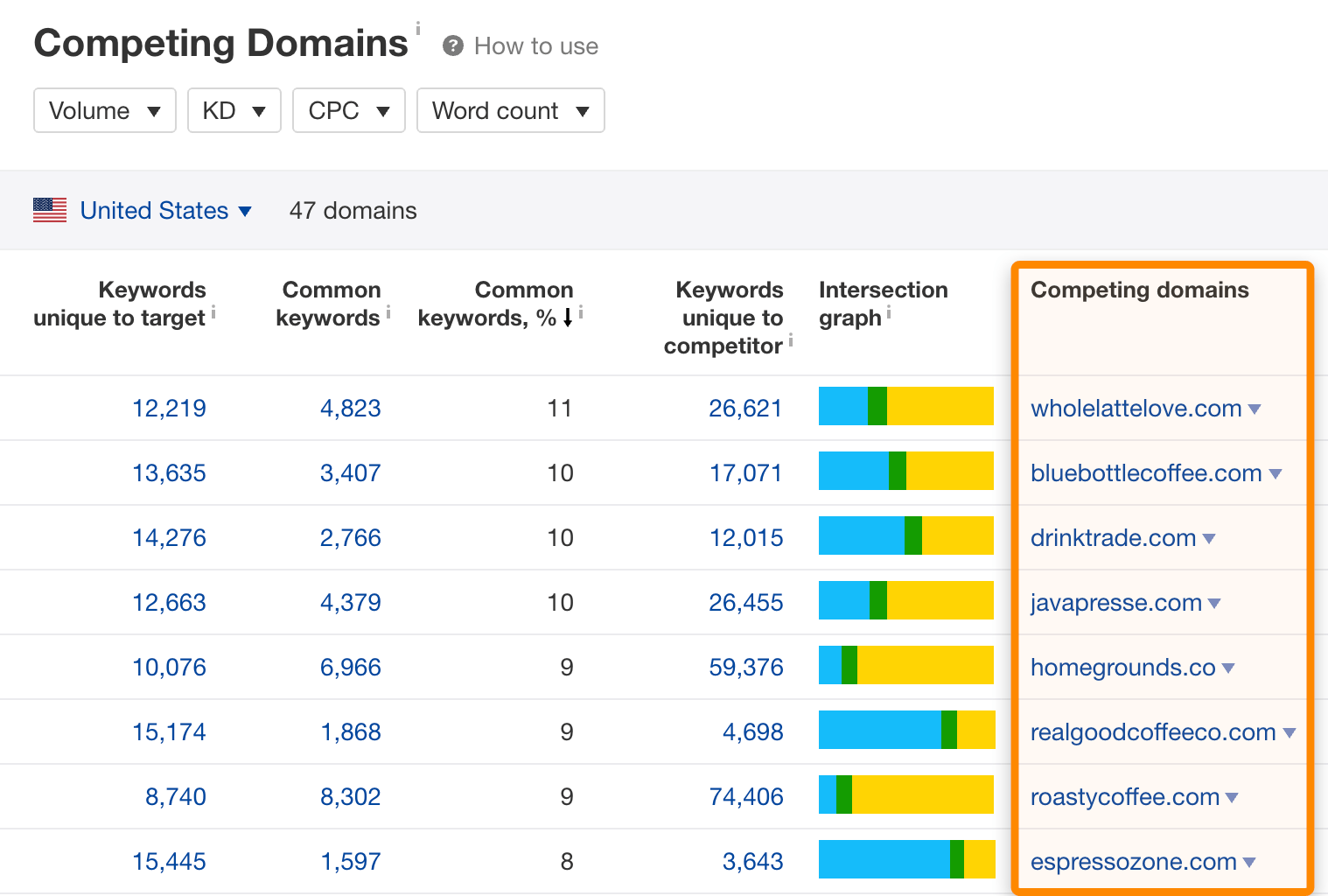
Competing Domains report in Ahrefs’ Site Explorer.
You can repeat the process above over and over for near-unlimited keyword ideas.
Use keyword research tools
Competitors can be a great source of keyword ideas. But there are still tons of keywords your competitors aren’t targeting, and you can find these using keyword research tools.
Keyword research tools all work the same way. You plug in a seed keyword, and they pull keyword ideas from their database based on that keyword.
Google Keyword Planner is perhaps the most well-known keyword tool. It’s free to use, and although it’s mainly for advertisers, you can also use it to find keywords for SEO.
Search volume
Search volume tells you the average number of times a keyword gets searched per month.
There are three important things to note about this number:
- It’s the number of searches, not the number of people who searched. There are cases where someone might search for a keyword multiple times a month (e.g., “weather in singapore”). These searches contribute to the search volume, even though it’s the same person doing them.
- It doesn’t tell you how much traffic you’ll get by ranking. Even if you manage to rank number one, your traffic from a keyword will rarely exceed 30% of this number. And that’s if you’re lucky.
- It’s an annual average. If there are 120k searches for a keyword in December and none for the remaining eleven months of the year, it’s monthly search volume will be 10k (120k / 12 months).
Clicks
Many people might search Google for something, but that doesn’t mean they all click on search results and visit the top-ranking pages. That’s where the Clicks metric in Keywords Explorer comes in handy. It tells you the average number of monthly clicks on the search results for a keyword.
Keyword Difficulty
SEO professionals typically gauge the ranking difficulty of a keyword manually. That is, by looking at the top-ranking pages for their target keyword. They account for many different factors to judge how hard or easy it’ll be to rank:
- Number (and quality) of backlinks;
- Domain Rating (DR);
- Content length, relevance, freshness;
- Use of the target keyword, synonyms, entities;
- Search intent;
- Branding;
- etc.
This process varies from person to person, as there’s no consensus on precisely what is and isn’t important here. One person might believe that DR is important, and another might think that relevance plays more of a role. This lack of consensus makes life a little difficult for keyword research tool creators, as they each try to distill the ranking difficulty of keywords down to a single actionable score.
Cost Per Click (CPC)
Cost Per Click (CPC) shows how much advertisers are willing to pay for each ad click from a keyword. It’s more a metric for advertisers than SEOs, but it can serve as a useful proxy for a keyword’s value.
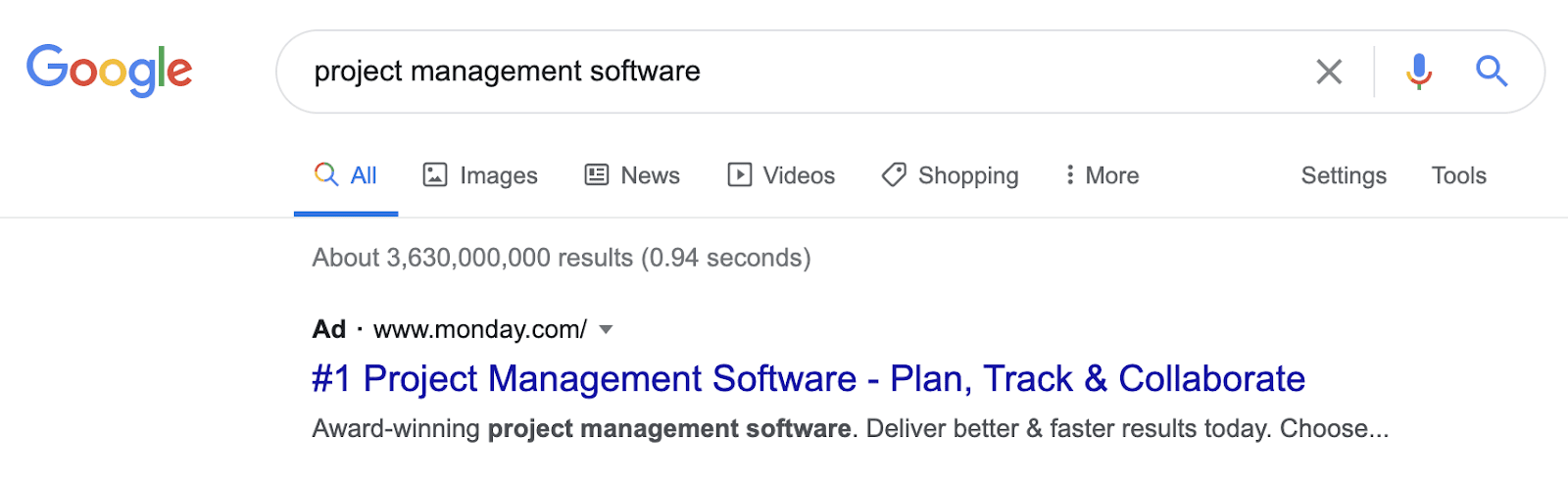
Monday.com pays for clicks from the keyword “project management software. It costs them money every time someone clicks this.
For example, the keyword “office coffee” has a relatively high CPC of $12. That’s because most searchers are looking to buy coffee machines for their office, which can cost hundreds or thousands of dollars. But it’s the opposite story for “how to make good espresso.” That’s because most searchers aren’t looking to buy anything. They’re looking for information on how to brew espresso.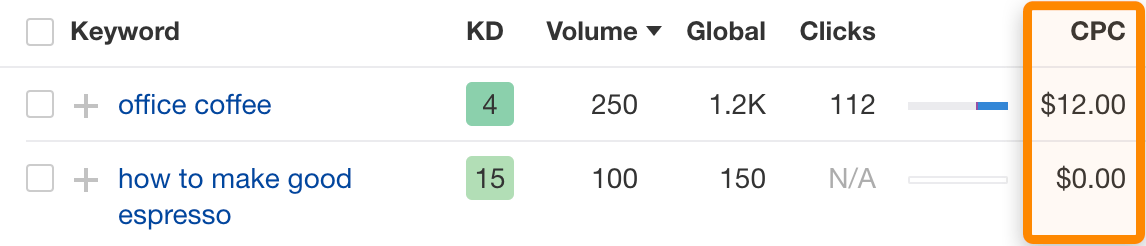
Estimated CPC for “office coffee” and “how to make good espresso” in Ahrefs’ Keywords Explorer.
However, one important thing to know about CPC is that it’s much more volatile than Search volume. While search demand for most keywords stays roughly the same from month to month, its CPC can change any minute. That means that the CPC values you see in third-party keyword tools are snapshots in time. If you want real-time data, you’ll have to use AdWords.

- Keyword Search Volume: Things You Didn’t Know You Don’t Know
- Why You Can’t Blindly Trust Keyword Search Volume for Traffic Estimations
- How to Use Google Trends For Keyword Research
- How Many Keywords Can You Rank For? [Study]
- Keyword Difficulty: How to Determine Your Chances of Ranking in Google
- What Are Long-tail Keywords? How to Find and Use Them

Chapter 4
How to target keywords
For every keyword on your list, you need to create the right kind of page and content to address it. Understanding how to do this is a crucial step in the keyword research process. Luckily, you can do it in two simple steps.
1. Identify the Parent Topic
Let’s say that you’ve got these keywords on your list:
- how to make whipped coffee
- what is whipped coffee
- whipped coffee recipe
- how to make whipped coffee without instant
- whipped coffee without sugar
You might be wondering, should you build a different page for each keyword or target all of them on a single page?
The answer largely depends on how Google sees these keywords. Does it see them as part of the same topic (i.e., how to make whipped coffee)? Or does it see them all as individual topics? You can get a sense of this by looking at the Google results.
For example, we see some of the same pages ranking for “how to make whipped coffee” and “what is whipped coffee.”
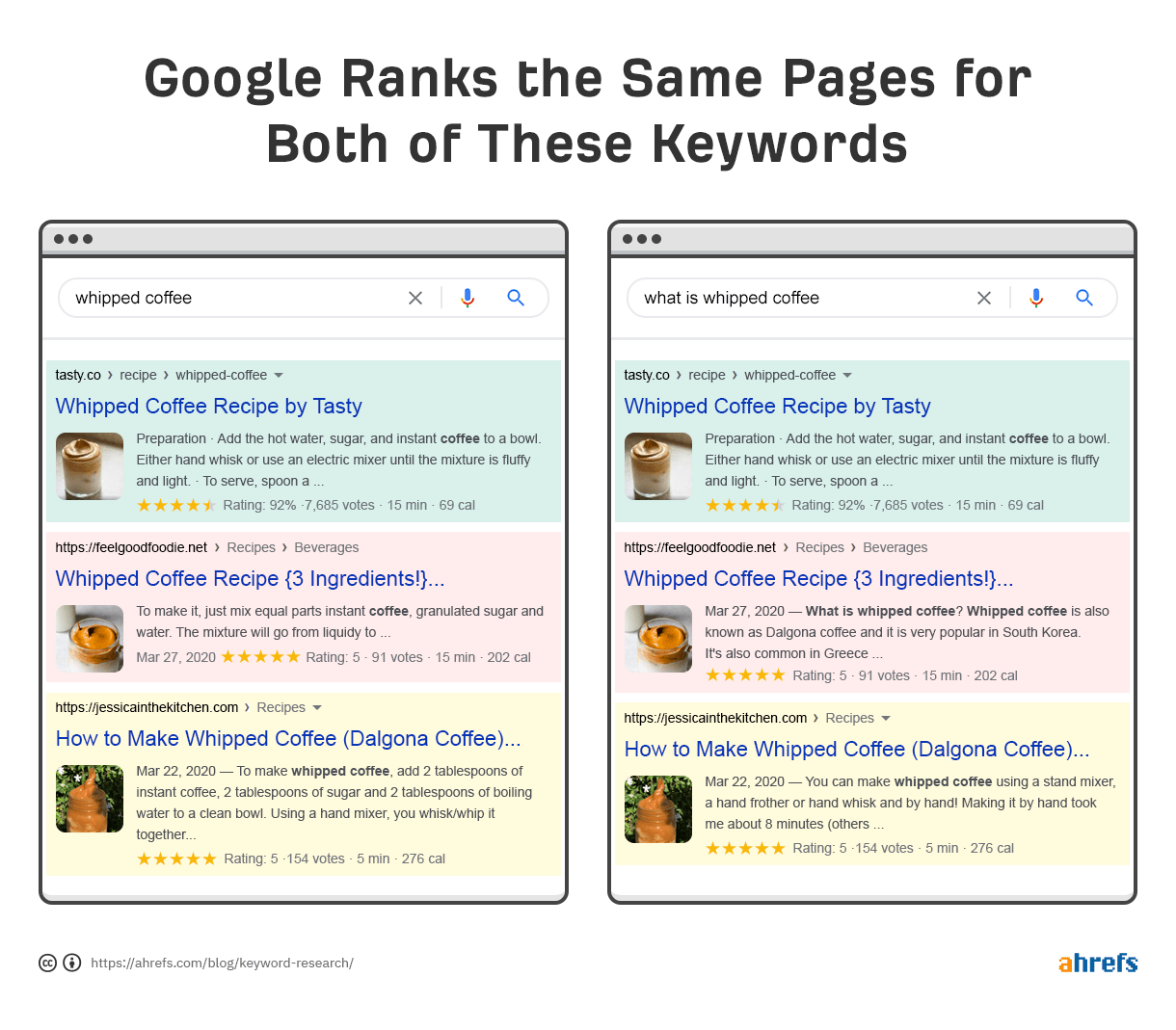
That seems to indicate that Google views both of these keywords as part of the same topic.
We also see that most of the results for both searches are posts about making a whipped coffee. That tells us that “what is whipped coffee” is a subtopic of the broader topic of how to make a whipped coffee.
For that reason, it would probably make more sense to target both of these keywords on a single page than to create two separate pages.
However, if we look at the results for “whipped coffee without sugar,” we see the opposite:
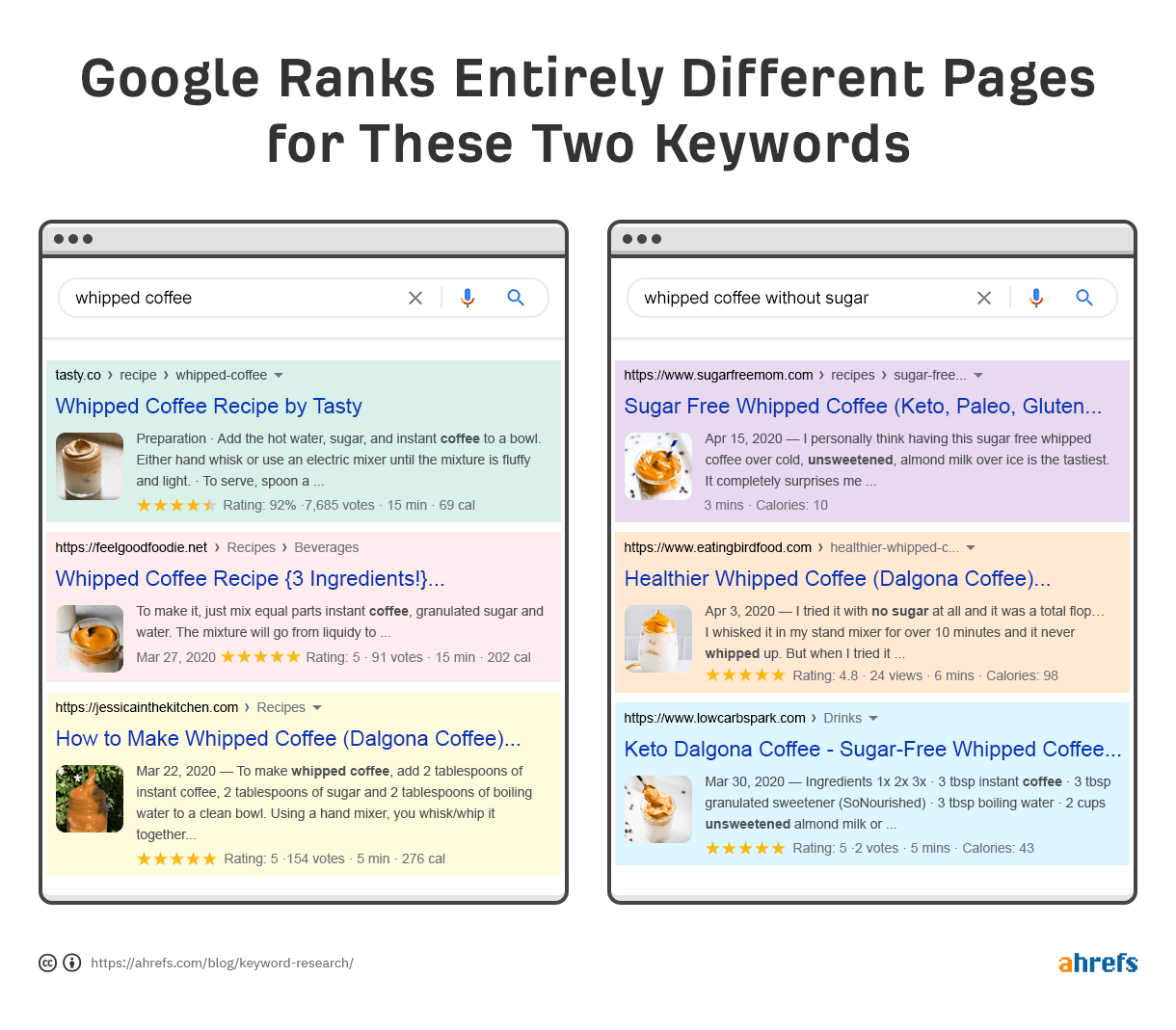
Almost all of the results are specifically about making a sugar-free, healthy whipped coffee, not just any old whipped coffee. That tells us that “whipped coffee without sugar” isn’t part of a broader topic of making a whipped coffee (even though a whipped coffee without sugar is, in fact, still a whipped coffee). So we’d probably need to write a separate guide to rank for this keyword.
The problem with this approach is that it’s very manual and slow, so if you have many keywords to analyze, it can take quite some time.
In Keywords Explorer, our solution to this problem is to show a “Parent Topic” for each keyword. It tells you whether we think you can rank for your target keyword while targeting a broader topic instead.
To identify the “Parent Topic,” we take the top-ranking page for each keyword and find the keyword that sends the most traffic to the page.
Let’s plug our keywords from earlier into Keywords Explorer and check their “Parent Topics.”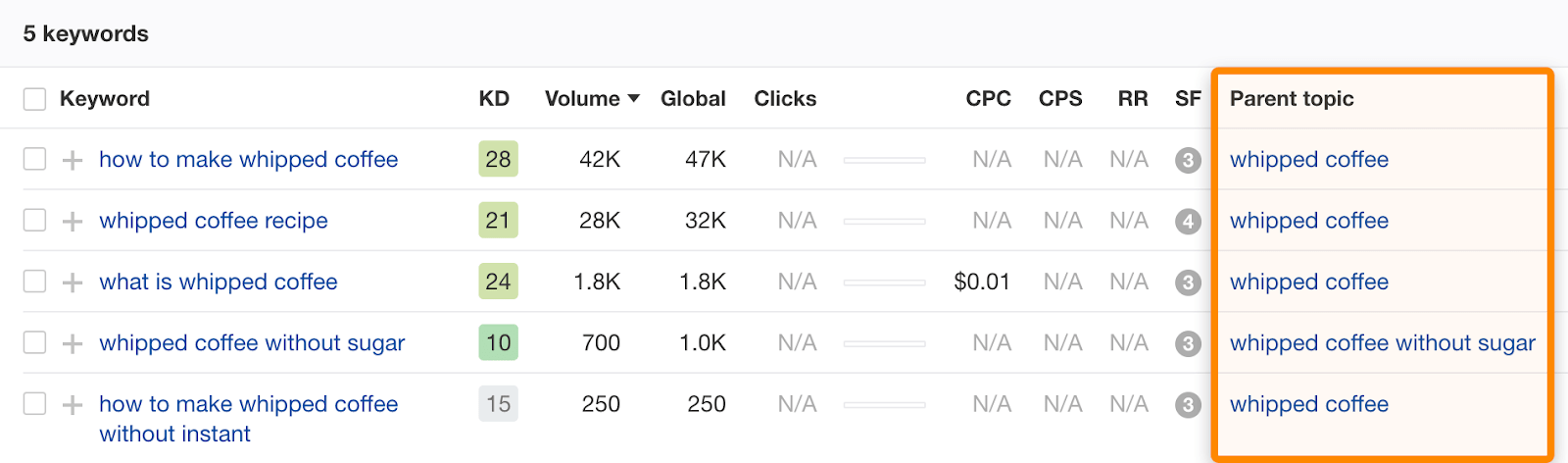
Parents Topics for our keywords in Ahrefs’ Keywords Explorer.
What we see here mirrors what we saw in the search results. Most of our keywords fall under the same broad topic. The exception is “whipped coffee without sugar,” so that would need to be a page of its own.
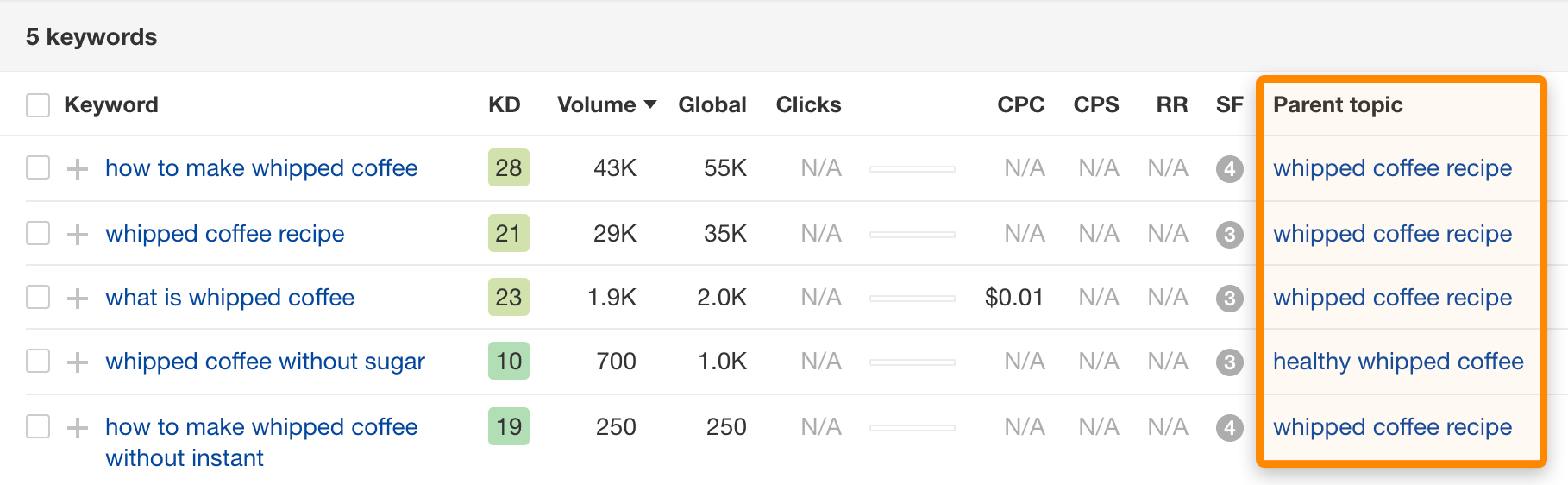
However, our Parent Topic feature isn’t perfect. It doesn’t always give you such straightforward advice on how to best group your keywords by page (in SEO, this practice is also known as “keyword clustering”) because Google’s search results are volatile.
For example, when I checked the Parent Topic for the same keywords as above shortly after publishing this guide, I got different results:
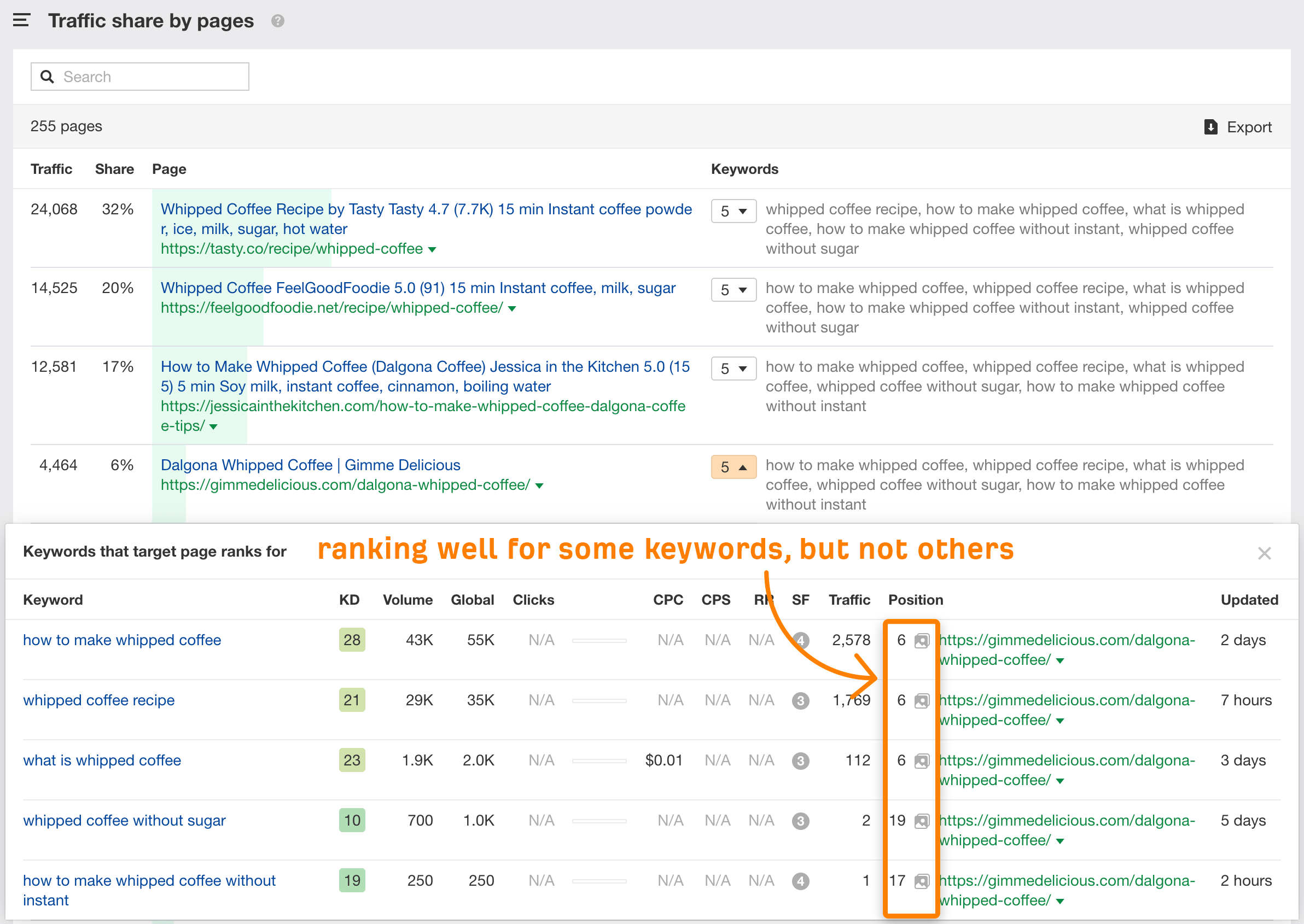
You might want to try using the “Traffic share > By pages” report in Keywords Explorer in such cases. It is an easy way to see if and where the same pages rank for your group of keywords.
2. Identify search intent
Let’s say that you have these keywords on your list:
- coffee grinder
- latte vs cappuccino
- single cup coffee maker
- arabica coffee
- how to brew cold brew coffee
- manual burr coffee grinder
If you run an online store with a blog, you need to understand which to target with blog posts vs. product pages.
For some keywords, this is obvious. You wouldn’t create a product page for “how to brew cold brew coffee” because that doesn’t make sense. Searchers want to know how to make cold brew coffee, not buy brewing equipment.
But what about a keyword like “manual burr coffee grinder?” Should you target this with a blog post about the best burr coffee grinders or an ecommerce category page showing all the burr coffee grinders you sell?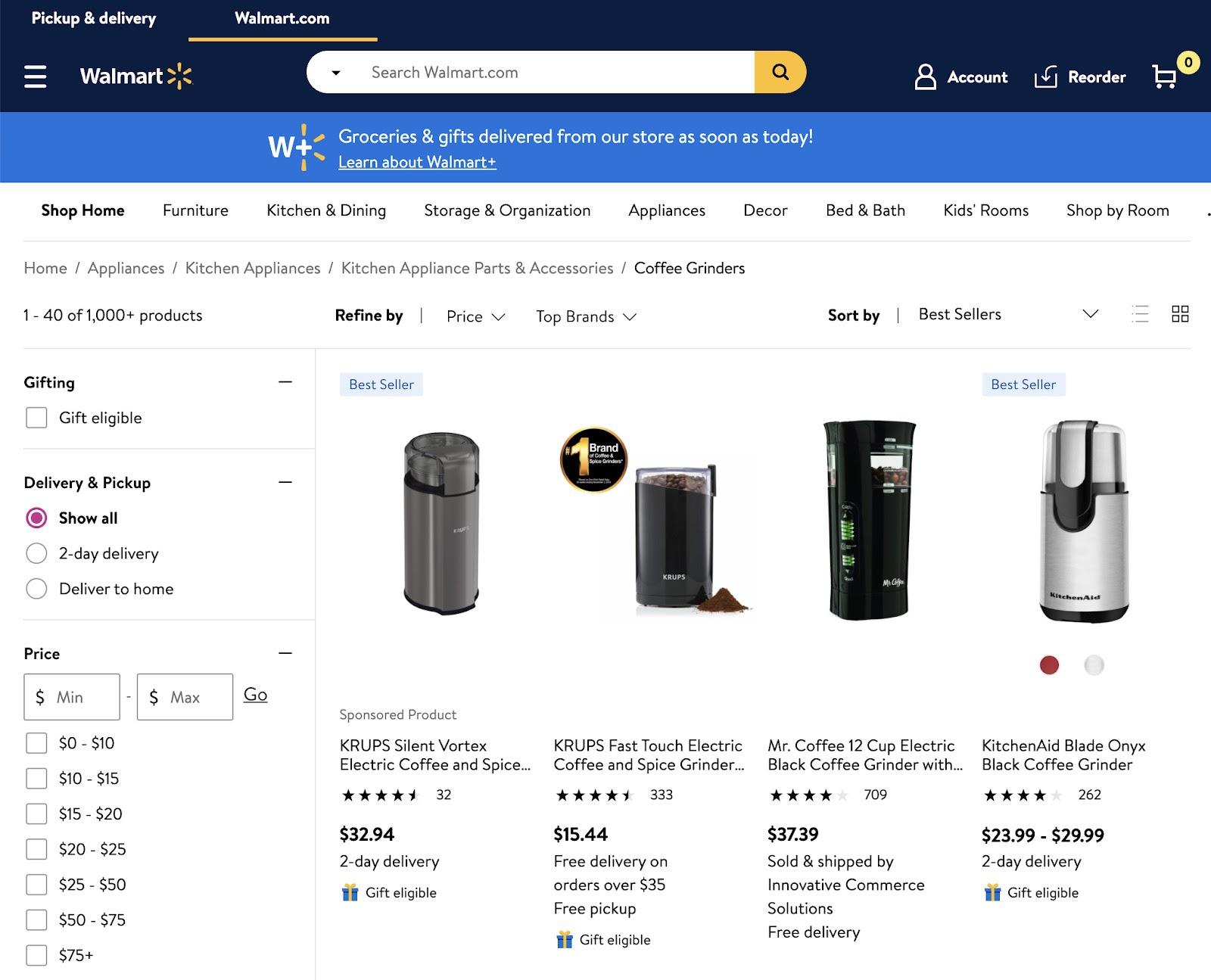
Example of an ecommerce category page.
Given that your goal is probably to sell more coffee grinders, your instinct is likely to create a category page with all the grinders you have for sale. That would be the wrong move because that kind of content doesn’t align with what searchers want to see—otherwise known as search intent.
How do we know? If you look at the top-ranking pages for this keyword in Google, they’re all blog posts about the best burr coffee grinders.
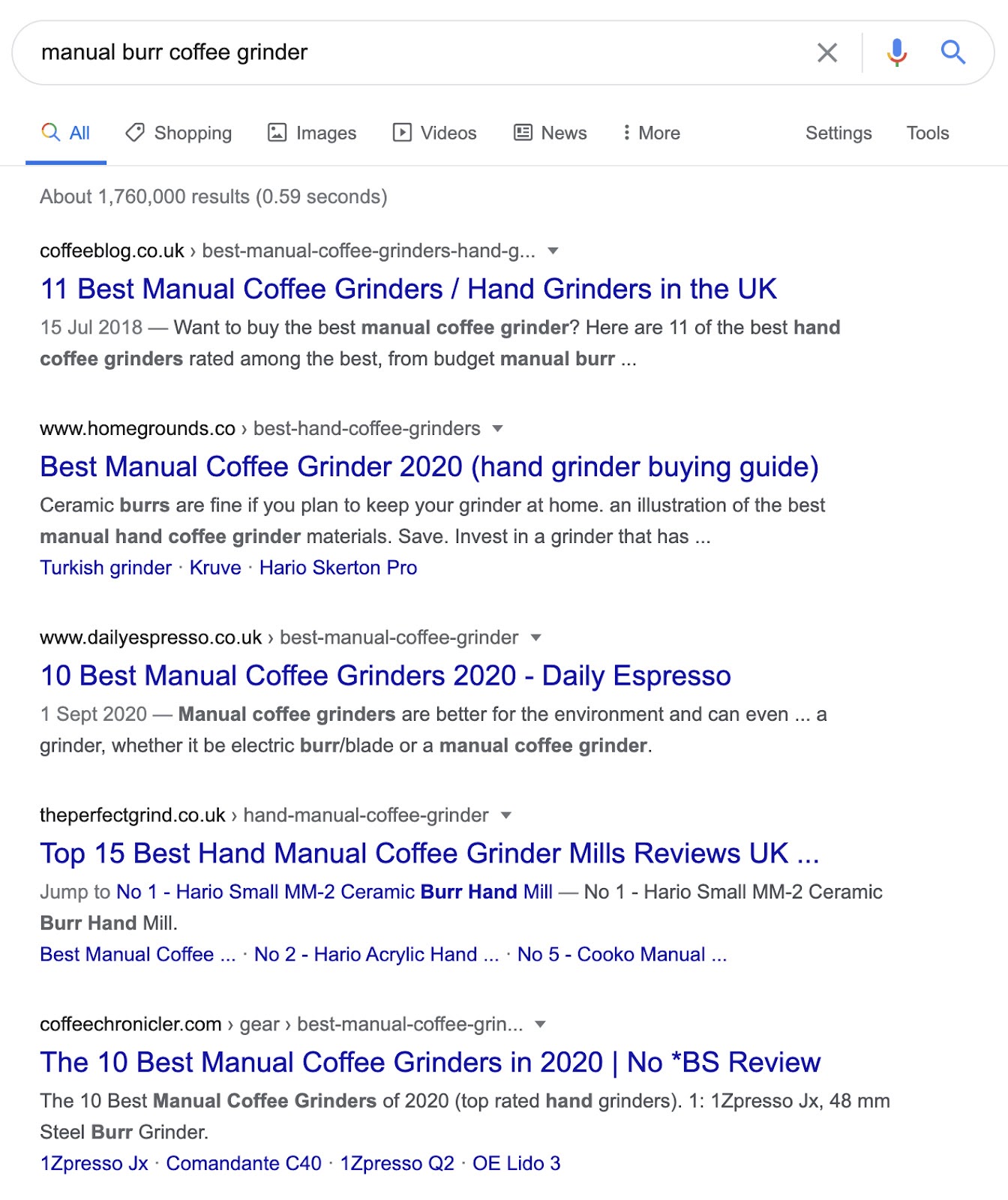
Google understands intent better than anyone, so the top results for a keyword are often a good proxy for search intent. If you want to stand the best chance of ranking, you should create the same type of content as you already see ranking on the first page.
You can view the top results for your country in Keywords Explorer. Just hit the “SERP” caret.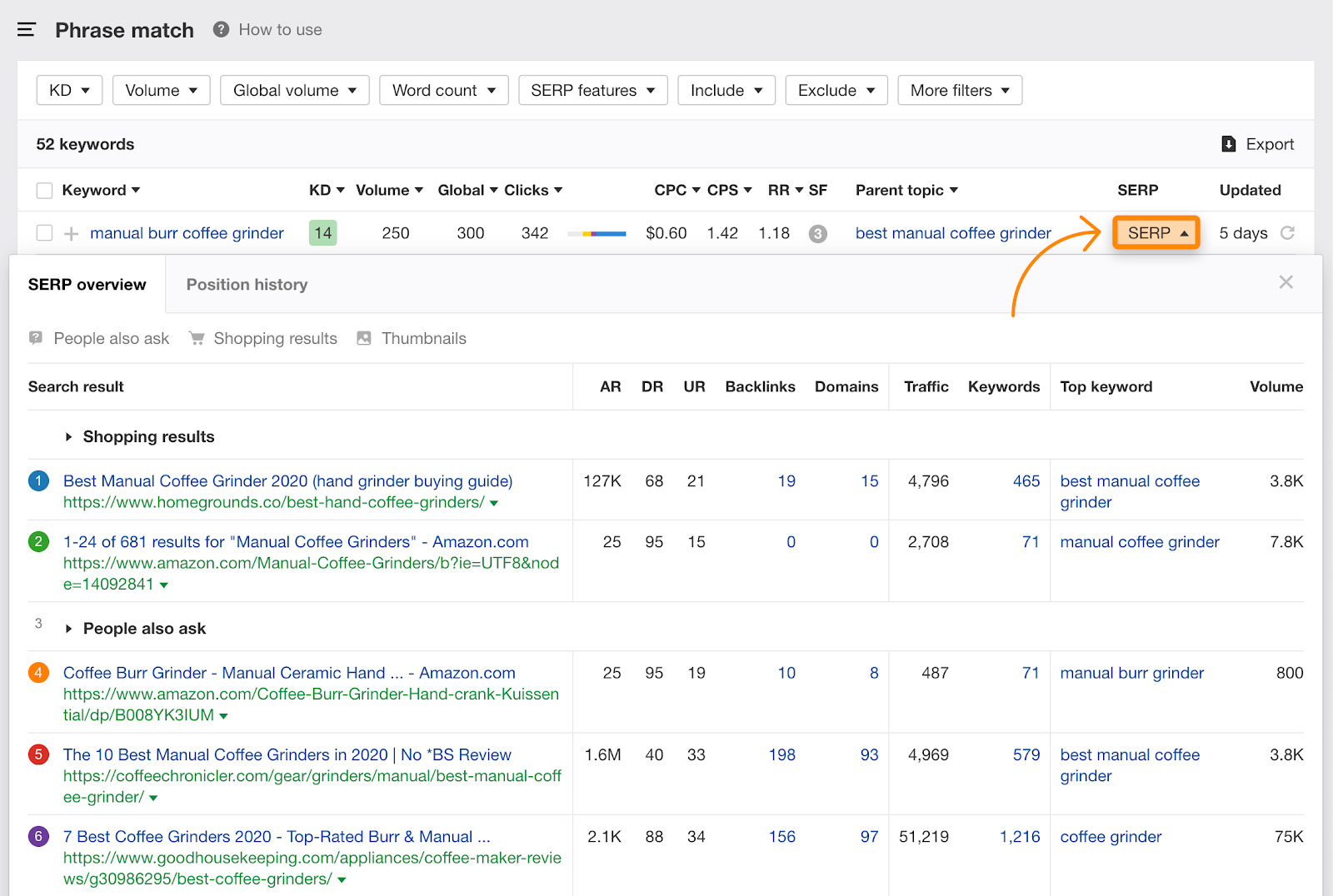
SERP overview for “coffee grinder” in Ahrefs’ Keywords Explorer.
Check our top Blog How to Use Chatbot in Digital Marketing?